
Releasing too late
Letting go when the cone is already over you means the Alert meter has already started climbing. Release before the light, not after it.
Beginner guide
A first-session walkthrough: what the interface is telling you, how camouflage actually behaves, and the mistakes that cost most players their first two lives.
The short version of how to play Mottle Game: drag to move, release to blend into the ground, stay out of the Seekers’ light cones, and survive the seek timer. Fireflies are 10 points each, and a full Alert bar costs one of your three lives.
Most guides to how to play Mottle Game begin with the controls. Begin with the interface instead: it has six numbers on screen, and every one of them matters. Most first-time players look only at the creature and the Seekers, then wonder why they lost a life they never saw coming.
On a phone, the layout changes: score, lives and round move to a single row at the top, the round countdown sits above the arena, and the Alert and Camo bars stretch across the bottom. The information is the same; only the arrangement is different.
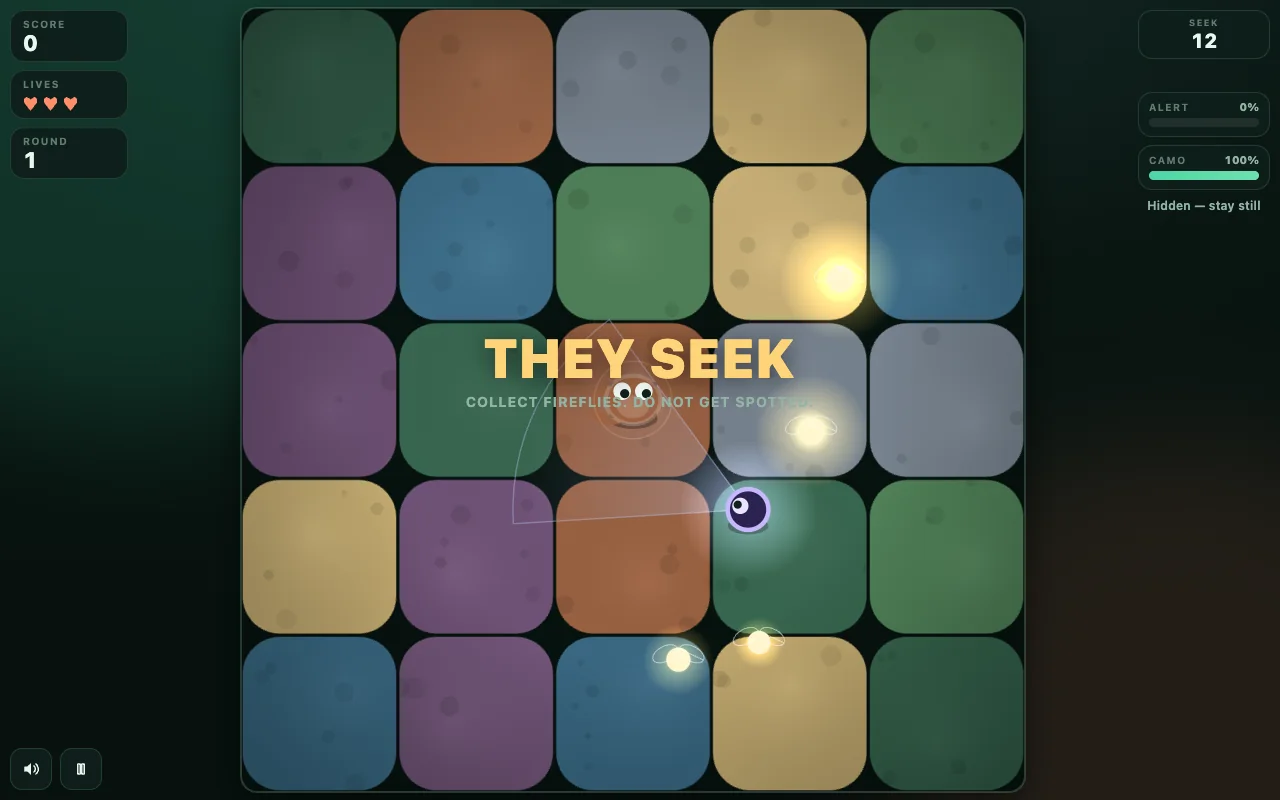
You are not trying to collect every firefly. You are trying to stay out of the Seekers' light until the seek timer runs out. Clearing the round pays a bonus of 100 × the round number, moves you to the next round, and keeps your lives. Fireflies are optional points along the way.
That distinction is most of how to play Mottle Game. It changes every decision you make. A player who treats Mottle as a collecting game will cross open ground for a 10-point firefly and lose a life worth far more. A player who treats it as a survival game takes the fireflies that happen to be on the way.
Click or tap the arena once. The game shows HIDE! with a countdown of three, and the Seekers hold still while they count. You can move during this window, and nothing can detect you.
Use it. Find the nearest firefly worth taking, note where the Seekers are starting, and pick a tile you can reach in one short drag. Players who spend the countdown waiting usually spend the first two seconds of the seek phase moving in the wrong direction.
Mottle does not use a virtual joystick. Press anywhere on the arena and your creature walks toward that point at a fixed speed. When it arrives it stops — but it does not hide, because your finger is still down. Lift, and camouflage begins where it stands.
On a keyboard, WASD and the arrow keys work as direct directional input. That matters for precision: a half-second tap moves you about a tile and a half, which is usually enough. Full details of both input methods are on the controls page.
Camouflage is not a hiding spot you choose. It is a state you enter by standing still, and it copies whatever tile you are on. Moss, clay, sand, stone, pond, heather — the creature takes the colour underneath and keeps only a faint pair of eyes.
The timing is the important part:
There is no better hiding tile. Because camouflage matches the ground exactly, a sandy tile and a pond tile hide you equally well. What matters is whether a cone is on you, and whether you were still long enough to finish blending.
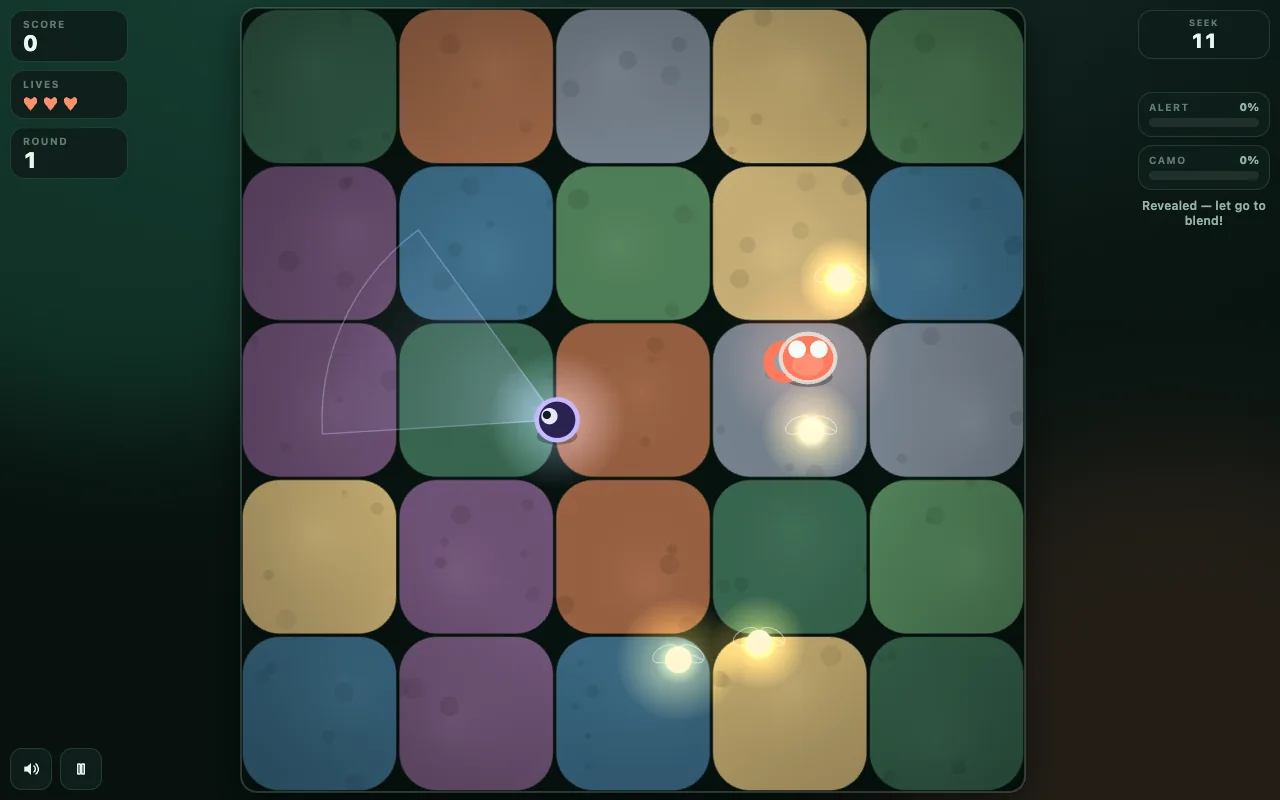
A Seeker is easy to watch and easy to misjudge. The body is slow; the cone is what catches you. At round one the cone is about 1.5 tiles long and roughly 58° wide, and it sweeps as the Seeker patrols.
Being inside that cone while visible fills Alert at about 58% per second. From zero, that is roughly 1.7 seconds of full exposure before you lose a life. Out of the cone, Alert drains at about 26% per second.
Two practical consequences:
Getting caught costs one life, resets Alert to zero, and restarts the same round — it does not push you forward. You will see the same layout again, which is a useful chance to learn it.
Fireflies are the only points on the board. Each one is worth 10, and the count grows with the round: four in round one, five in round two, up to nine. They do not move, and you collect them by touching them.
There is no bonus for collecting all of them, and no penalty for leaving some behind. If a firefly sits under a cone, it is worth exactly nothing to you until the cone moves on. This is the last piece of how to play Mottle Game: points are optional, survival is not.
Difficulty curve
These values were read from the live build on 15 November 2026. The creator can retune them, so treat the shape as reliable and the exact numbers as a snapshot.
| Round | Seekers | Seek timer | Cone reach | Fireflies |
|---|---|---|---|---|
| 1 | 1 | 13 s | ~1.5 tiles | 4 |
| 2 | 2 | 15 s | ~1.6 tiles | 5 |
| 3 | 2 | 17 s | ~1.6 tiles | 6 |
| 4 | 3 | 19 s | ~1.7 tiles | 7 |
| 5 | 3 | 21 s | ~1.7 tiles | 8 |
| 6 | 4 | 23 s | ~1.8 tiles | 9 |
| 7+ | 4 | up to 26 s | up to ~2.1 tiles | 9 |
Round one is the only round with a single Seeker. It is also the cheapest place to practise blending, because a single cone is easy to track.
Common mistakes
None of these are about knowing how to play Mottle Game. They are about doing it while a cone is closing.
Letting go when the cone is already over you means the Alert meter has already started climbing. Release before the light, not after it.
A long drag keeps you visible for the whole trip and commits you to it. Short hops cover the same ground, but you can stop at any tile and re-hide.
The round pays out for surviving, not for clearing the board. A firefly behind three cones is a trap with a 10-point label.
It is the only warning you get. If it is over 50% and climbing, stop moving and break line of sight before you do anything else.
Every tile hides you equally well once camo is at 100%. Walking further to a tile you like the look of just adds exposure.
A catch resets Alert and replays the round. Slow down, use the countdown, and take the fireflies you can actually reach.
Here is how to play Mottle Game from the first countdown to the round clear.
Questions
No. Rounds end when the seek timer runs out, and you keep any points you collected. Fireflies are optional; surviving is not.
No. Movement reveals you in about 0.22 seconds and adds a visible glow. Camouflage only builds after you release the pointer — holding your finger still keeps you exposed.
Either you were already inside the cone when the meter finished filling, or you moved before the cone had passed. Camo hides you from sight, but it does not stop Alert that is already rising.
Round one has a 13-second seek phase after a three-second countdown. Each later round adds two seconds, up to a maximum of 26 seconds of seeking.
One round is enough to learn how to play Mottle Game at a basic level. The controls take seconds; the timing that keeps you alive takes a few rounds, because you have to see a cone sweep before the advice makes sense.
Yes, but only in the browser you played in. The score is stored by the game inside the page, so it does not follow you to another browser or device.
Keep going